Showing posts with label Buildings. Show all posts

Sunday, 18 September 2016

Building a Spanish Colonial Church


I decided that terrain for my Ten Years War in Cuba project needed a few more buildings and thought that I would add a plantation owner's house and the different parts of a sugar mill. But I decided to begin with a small Spanish colonial church. After a quick search on the internet I sketched out the sort of thing I had in mind before drawing up a more detailed plan:


Next stage was to cut out the various parts from a sheet of foamboard. I cut two gable ends and stuck one of them on the back of what was to become the front of the church so that the roof could later be fixed in place:


If you are not familiar with joining foamboard components together here is a useful technique. Draw a line down one on the edges that are to be joined, make it the same thickness as the foamboard itself. Carefully cut through the paper backing along your line and then scrape out the foam filling leaving the other side of the paper untouched as you can see in this photograph:


In this example the gable end can now be glued into place leaving a nice neat joint when viewed from the outside. I tend to use balsa cement as it sets quite quickly and I then reinforce the joints with triangular fillets made from whatever scrap pieces are lying around:


Here you can clearly see the second gable end cemented into place on the back of the church façade ready to support the roof:


All four walls in place and each corner strengthened with a couple of triangular fillets as mentioned earlier:

The curve on the front wall had quite a rough finish which I thought would spoil the look of the finished model:
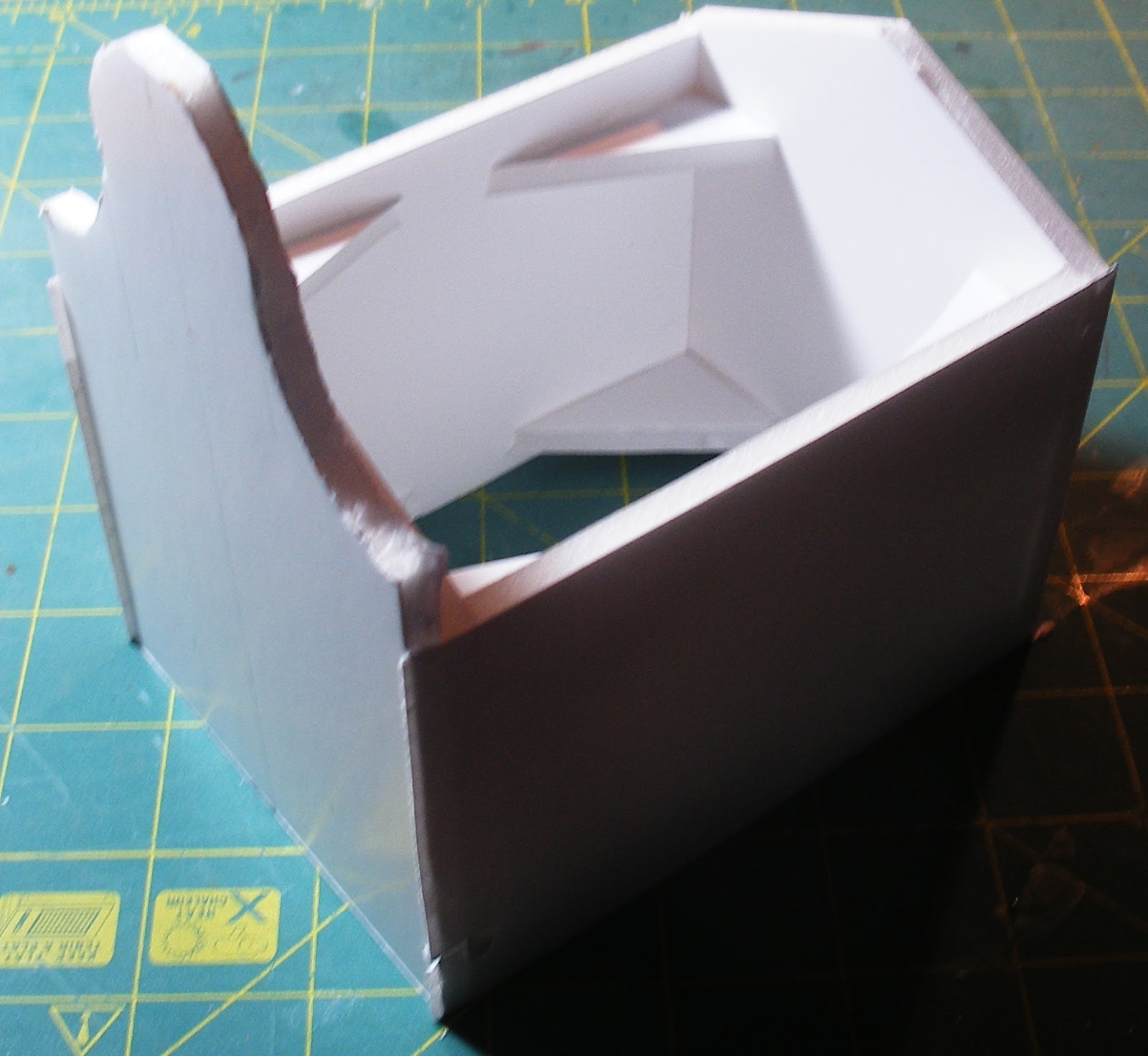
 

To disguise the rough cut I faced the edge with a strip of tough cartridge paper and topped that off with a second strip to add a little texture, then I fixed the roof in place and mounted the whole model on a base to which I could add steps where the front door was to be placed:

I used tile textured plastic card from Wills railway modelling accessories for the roof and made a ridge tile from a bamboo skewer:


The door frame and a small recess were added along with corner stones, all made from thin plastic card or cartridge paper:


Various other courses of stonework were added in a similar way just to improve the look of the whole thing and add interest:


In exactly the same way I added window frames and ledges to both sides of the building:


I added a single large window on the back wall and noticed that the joint between the roof and the front wall was quite scruffy. To rectify this I ran glue along the joint and then put strips of thin plastic rod in place to a give a neater finish - you can see these dark coloured strips in the photograph:


The next step was to spray paint the whole thing. I used a white primer since I intended that the building would be mainly white when it was finished, and I gave it several coats so that the different textures of all the materials I had used would blend together:


 Finishing touches included painting the roof, doors and windows:


I added a cross which was just a suitably shaped section from the runner in a plastic kit, glued into place and painted.


Originally I had planned to place a statue in the recess above the door but I couldn't find anything suitable. As an alternative I found a picture of an icon on the internet, reduced it in size and glued it in place where it passes quite well as a mosaic:


Final touches were the use of different washes to give a weathered effect and detailing on the door.


The windows were simply filled in with black paint, I had wanted a stained glass effect in the large window at the back but so far I have not been able to find anything suitable.


Finally I placed the finished model in its setting, a small settlement on the edge of my sugar plantation with the Cuban jungle in the background.


Overall I am fairly pleased with the result and it made such a nice change from painting figures!


Tuesday, 9 August 2016

Buildings and Crops for my Ten Years War in Cuba Project

Once my jungle was complete it was time to add a few buildings and fields to represent the plantations and agricultural settlements around which much of the war was to revolve. First of all I made a couple of shacks which would have housed slaves and agricultural labourers:


Here is a close up of one of the shacks, you can see them both in views of the completed jungle. Made from foam board to a very simple design with card and coffee stirrers. The roof was made from card and covered with pva glue and raffia.

I also built a small jungle hut; it can either be used as part of the main settlement or set off deep in the jungle as a base for some of the Cuban insurgents:


Again I used a very simple construction method, in this case everything was based on an empty Pringles tube! I cut the tube down to size, covered it with pva glue and lengths of skewers held in place with elastic bands until the glue dried. A simple card roof was added and to this I glued palm leaf shaped pieces of painted card; detailing was finished with a black felt tipped pen.

The agricultural economy was crucial to Spain and in efforts to protect this source of wealth the armed forces constructed many blockhouses - later on in the was a whole line of them was constructed (the Trocha) cutting the island into two and isolating the rebels at the Eastern end.


I used foam board again with coffee stirrers for the door and lining the loopholes. The roof was made with corrugated card glued into place, painted and detailed with a felt tipped pen as before.


That completed my initial settlement though I plan to add more as the project progresses; ideally I would like another couple of huts, a church and perhaps a more substantial plantation owners house. It would also be interesting to build a mill and boiling house since these were vital buildings on any plantation, but that's in the future.  When I eventually get round to building them I will feature them here but for the moment the next thing I needed was fields or crops.

Sugar cane was crucial to the Cuban economy and was a source of great wealth for the Spanish Government, so a field of the stuff was next on my list:


I made it by drilling rather a lot of holes in a piece of wood ! Into these I glued pieces of skewer which I had painted and partially split at one end; then, very painstakingly I glued leaves into the split ends. Not strictly botanically accurate but good enough for my purposes and good enough to restrict the passage of troops just like the real thing.


Various bits and pieces of greenery that I had left from making the jungle were glued to another base to make a small field of mixed crops. This was an essential part of any plantation since the crops were used to feed the slaves and other workers:


A final addition, and essential for the diets of the agricultural population, were plantains or bananas to you and I. Another base board was drilled and then filled with suitable looking bits and pieces from my jungle raw materials. Once the glue was dry I had the fiddly job of painting the appropriate parts bright yellow to represent my bananas:


Again they may not be entirely correct from a botanist's point of view.....but hey! Making model bananas is not something that I do every day.